The Complete Guide to Class A Foam in Wildland Firefighting
Class A foam multiplies the effectiveness of every gallon of water on the fireground. Here is how it works, when to use it, and what to look for in a modern foam system.

Water alone has been the primary weapon against wildland fire for more than a century, and it will continue to be. But water on its own is not always efficient. A significant percentage of every gallon you pump runs off the fuel or evaporates before it can do useful work. Class A foam changes that equation. Used correctly, it can effectively double or triple the fire-suppression value of every gallon that leaves your discharge, extend mop-up, and dramatically improve the odds of holding a line during a wind-driven run.
This guide walks through what Class A foam actually is, how it interacts with wildland fuels, when and where it belongs in your tactics, and how modern solid stick foam technology is reshaping the way rural and wildland fire departments plan their operations.
What Class A Foam Actually Is
Class A foam is a surfactant-based additive designed specifically for use on ordinary combustibles: grass, brush, timber, structural wood, and other cellulose-rich fuels. Unlike Class B foams, which are formulated to blanket flammable liquids and seal vapors, Class A foam is engineered to do three things to water.
- Reduce surface tension so water can penetrate deeply into fuels rather than beading up on the surface.
- Create a bubble structure that holds water in place on vertical and horizontal surfaces so it has time to absorb heat.
- Insulate unburned fuel from radiant heat when applied ahead of the fire as a wet line or foam blanket.
Because Class A concentrate is used at very low ratios — typically 0.1 percent to 1.0 percent by volume — a small amount of concentrate delivers a large operational payoff. A single gallon of concentrate at a 0.5 percent mix rate treats roughly 200 gallons of water. That is a meaningful multiplier when you are working out of a 200-gallon skid unit far from the nearest hydrant.
The Physics: Why Foam Works
The reason foam is effective is not marketing. It is chemistry and physics.
Water suppresses fire primarily by absorbing heat. A gallon of water can absorb roughly 9,000 BTUs as it warms from ambient temperature to 212 degrees Fahrenheit, and another 8,000 BTUs as it converts from liquid to steam. But water only absorbs that heat while it is in contact with hot fuel. The instant it runs off or evaporates without contacting the fuel, that cooling potential is lost.
Class A foam addresses both problems. The surfactant reduces the surface tension of water from roughly 73 dynes per centimeter to under 30 dynes per centimeter. That lower surface tension means the treated water can wet punky logs, penetrate duff, and soak into dense fuel beds that plain water would simply run off of. In mop-up, that difference is the difference between a smoldering stump reigniting the next afternoon and a stump that is truly out.
The bubble structure adds a second effect. A foam blanket applied to fine fuels stays in place, releasing water gradually as the bubbles break down. Applied as a wet line, that blanket also acts as a reflective and insulating barrier against radiant heat, buying time for burnout or direct attack.
Where Class A Foam Belongs in Your Tactics
Foam is not a universal replacement for water. It is a tool with specific best uses on the wildland fireground.
Direct attack in light and flashy fuels
In grass, sage, and light brush, treated water knocks flame down faster and stays put longer than plain water. Crews using foam on a moving grass fire can typically stretch a tank of water twenty to forty percent further than they could with plain water alone.
Structure protection in the wildland-urban interface
Coating siding, decks, wood-shake roofs, and adjacent vegetation with a Class A foam blanket ahead of an approaching front is one of the most cost-effective protective measures available. The blanket reflects radiant heat, prevents ember ignition of receptive fuels, and gives you time to move to the next structure.
Mop-up and overhaul
This is where Class A foam most often earns its keep. Foam-treated water penetrates the duff layer, saturates stump holes, and reaches the smoldering interior of large fuels that plain water can not reach without hours of extra effort. Mop-up crews with foam do more with fewer people and less water.
Fireline construction and holding
A wet line laid with treated water — especially in the last few feet of unburned fuel next to your control line — is far more resistant to slop-over than a plain-water wet line. In wind events, that difference can decide whether you hold the line or lose it.
Where Foam Is Not the Answer
Foam is a tool, not a religion. There are situations where it is the wrong choice.
In heavy timber with active crown fire, no amount of foam sprayed from a portable pump is going to change the outcome. In those conditions, aircraft, dozers, and disengagement are the answers.
Foam is also inappropriate in and around live water. Even the most modern Class A concentrates are surfactants, and surfactants are toxic to fish and aquatic invertebrates in high concentrations. Standard practice is to avoid application within a hundred feet of streams, ponds, and wetlands, and to draft water and mix downstream of sensitive habitat where feasible.
Liquid Concentrate: The Traditional Approach
For most of the past forty years, Class A foam has meant liquid concentrate — five-gallon pails and fifty-five-gallon drums of amber liquid mixed into the water stream by an around-the-pump proportioner, an in-line eductor, or a direct-injection system driven off the pump.
Liquid concentrate works. It is proven, it is widely available, and every wildland fire agency in the country has trained on it. But it also has real operational costs that departments have quietly accepted for decades.
- Weight and volume. A five-gallon pail of concentrate weighs about forty-five pounds and takes up a fixed footprint on the truck.
- Storage. Concentrate must be stored in temperature-controlled space and typically has a shelf life measured in years, not decades.
- Spill liability. A pail dropped in a station bay is a hazmat event. A drum that leaks during transport can trigger reporting requirements.
- Calibration. Around-the-pump proportioners and eductors need to be tested and calibrated regularly. A drifted proportioner can under-mix, leaving crews with essentially plain water, or over-mix, wasting expensive concentrate.
- Cross-contamination. If a check valve fails on an around-the-pump system, concentrate can migrate backward into the water tank. Once that happens, every future draft from that tank is compromised until the tank is drained, flushed, and refilled — often at the worst possible time.
None of these are dealbreakers. All of them add up.
Solid Stick Foam: A Different Approach
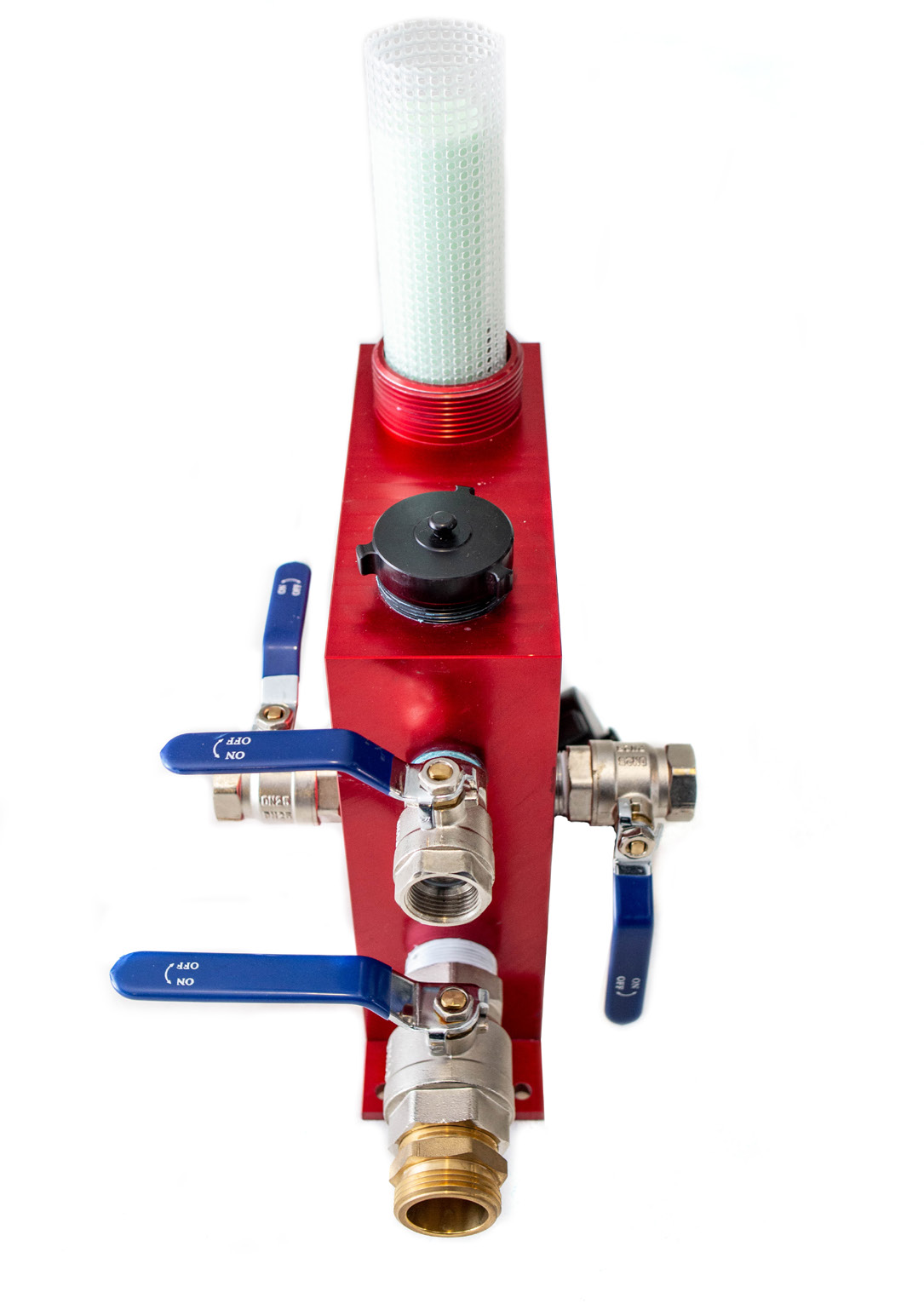
Solid stick foam is a relatively recent evolution. Instead of a liquid concentrate injected into the water stream, the concentrate is manufactured as a dense, cylindrical stick that dissolves at a controlled rate when water flows past it. The stick sits in a purpose-built mixing chamber on the discharge side of the pump. As water flows through the chamber, it picks up a metered amount of foam agent and delivers a consistent solution to the hose.
The Solid Foam Stick Manifold produced by Armour Fire Solutions is one implementation of that approach. The manifold sits between your pump discharge and your hose lays. When you want foam, you open a valve; when you want plain water, you close it. No injection pump. No proportioner. No electronics. No calibration drift.
The operational advantages are direct:
- Sticks store on a shelf and weigh a fraction of the equivalent liquid volume for the same water treated.
- There is no proportioner to fail. Nothing to calibrate season to season.
- Because the manifold sits on the discharge side, there is no plumbing path for concentrate to migrate back into the water tank. Cross-contamination is eliminated by design.
- Setup on-scene is measured in seconds. Open a cap, drop a stick, close the cap, open the discharge.
For departments that already have around-the-pump systems and are comfortable with them, this is not necessarily a reason to change. For departments building a new skid, replacing an aging proportioner, or spec-ing a first foam system, solid stick is worth serious consideration.
Choosing a Foam System for Your Department
When evaluating a Class A foam system — solid stick or liquid — ask these questions before signing a purchase order.
First, where does the foam get introduced? Intake-side systems are simpler but carry cross-contamination risk. Discharge-side systems eliminate that risk but require slightly more thought about pressure balance.
Second, what is the total lifecycle cost per treated gallon? Divide the annual cost of concentrate, calibration, disposal, and consumables by the number of gallons you actually treat in a year. A cheaper concentrate that requires a $3,000 proportioner rebuild every three years is not cheaper.
Third, how simple is on-scene operation? A system that requires a specific pump RPM range, a specific discharge pressure, or a specific valve sequence is a system that will fail under stress. Look for one-motion operation.
Fourth, what happens when it breaks? Field-repairable is worth a lot. A sealed proportioner that has to be sent back to the manufacturer for service is a system that spends part of the season on the shelf.
Training and Documentation
Any foam program is only as good as the training behind it. At a minimum, crews should be comfortable with:
- Reading and understanding a foam concentrate safety data sheet.
- Calculating mix ratios for the specific concentrate and system in use.
- Recognizing and correcting common problems: no aspiration, wet foam versus dry foam, plugged nozzles.
- Documenting foam use for after-action reports and reimbursement.
Written standard operating guidelines for when to use foam, what mix rate to use, and how to document application do a great deal to standardize decisions across shifts and crews.
The Bottom Line
Class A foam is not new. It has been in the wildland toolkit for four decades. What is new is that solid stick technology has removed most of the operational friction that kept smaller departments from adopting foam in the first place. If your agency has been on the fence — put off by drums, calibration, and cross-contamination worries — the current generation of solid stick manifolds deserves a hard look.
The math on foam has always favored the fireground. It is worth making sure the math on your foam system does too.
Ready to see the numbers?
Run our interactive ROI calculator with your own inputs.